

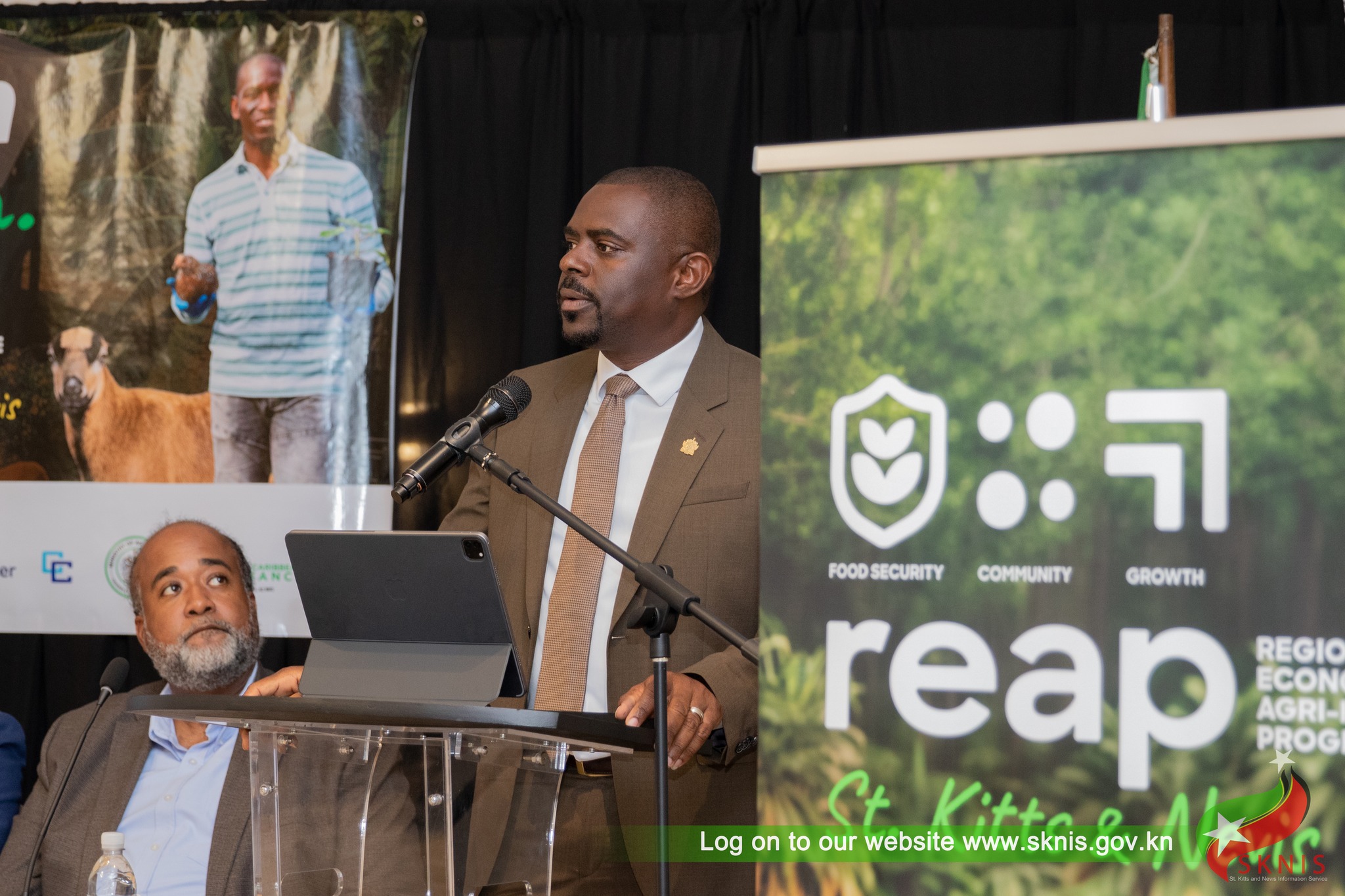
Basseterre, Saint Kitts, March 17, 2026 (SKNIS): The Government of Saint Kitts and Nevis, through the Ministry of Agriculture, Fisheries and Marine Resources, has officially launched the Regional Economical Agri-Insurance Programme (REAP), a transformative initiative designed to protect farmers and fisherfolk, strengthen the agricultural sector, and build resilience against climate change.
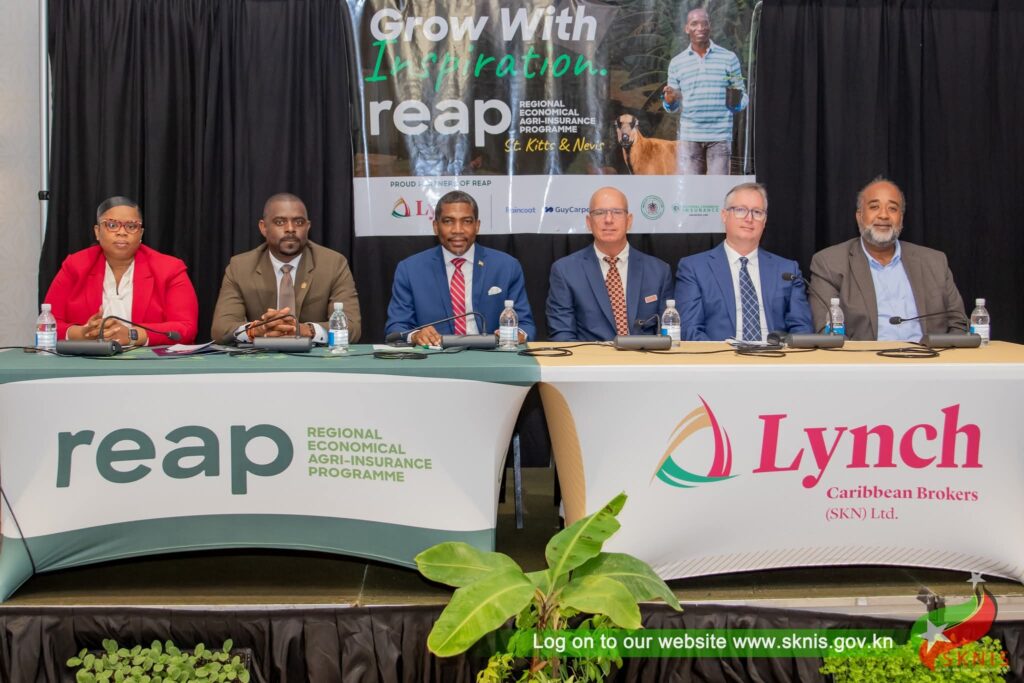
The programme, launched on March 17, 2026, during a ceremony at the St. Kitts Marriott Resort, is being implemented in partnership with Lynch Caribbean Brokers Limited and National Caribbean Insurance (NCI).
Delivering remarks at the launch, Minister of Agriculture, Fisheries and Marine Resources, Honourable Samal Duggins, said that REAP represents a major step forward in safeguarding the livelihoods of those who feed the nation.
Minister Duggins emphasised the government’s commitment to standing with the nation’s “food heroes.”
“For decades, we have asked our farmers and fishers to take the risks—to plant, to invest, and to produce. But when disaster came, too many were left to recover on their own. That ends today,” Minister Duggins affirmed.
He underscored that REAP is grounded in a simple but powerful principle – “if you feed this nation, this nation will protect you.”
“This protection is not for a select few. It is for all—our crop farmers, livestock farmers, and fisherfolk. Food security is not just a slogan; it is a matter of national survival. And those who make it possible are not just workers—they are our heroes,” he said.
The minister explained that REAP introduces a modern, parametric insurance model tailored to the realities of Saint Kitts and Nevis and the wider Caribbean. The system uses real-time data, satellite monitoring, and predefined triggers to activate payouts automatically when adverse conditions such as drought or storms occur.
“In agriculture, timing is everything. If recovery takes months, you lose a season; if it takes too long, you lose a livelihood. REAP is designed to eliminate delays, reduce paperwork, and remove uncertainty. When thresholds are met, payouts are triggered—not in months, but in weeks,” Minister Duggins noted.
He added that beneficiaries can receive support in as little as two to three weeks after a triggering event, enabling them to replant, rebuild, and recover quickly.
The government is also making a significant financial commitment to ensure the programme’s success, allocating one (1) million dollars annually to support participation and accessibility.
“We are not asking our farmers and fishers to carry this burden alone. We are covering premiums, structuring access, and ensuring inclusion. Protection must not be a privilege—it must be a right for all our food heroes,” the Minister affirmed.
The launch of REAP marks a critical milestone in the Federation’s ongoing efforts to modernise agriculture, enhance climate resilience, and secure a sustainable future for its people.
-30-